
Your company might already offer benefits that could help women manage menopause symptoms. Flexible working arrangements, mental health support, prescription drug coverage, access to specialists.
All useful. All potentially relevant.
But there's a problem.
In a survey conducted by the Society for Women’s Health Research and the Fuchsia Tent, employees were asked which benefits their employers offered. Most could identify the aforementioned benefits. But when asked whether their employer offered menopause-specific support, fewer than 10% said yes.
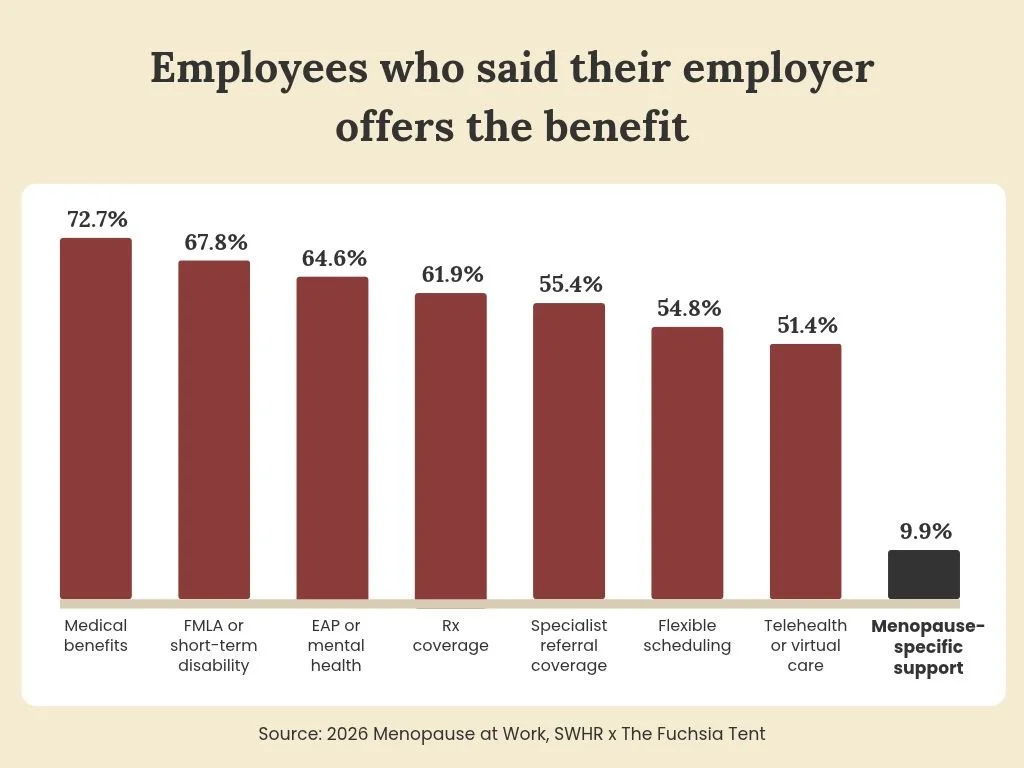
These results show a pretty significant disconnect.
Because those same benefits the employees knew about could make a real difference to someone experiencing menopause symptoms.
In other words, your company may already be providing support for women going through menopause. They just don't know it.
This isn't necessarily a benefits problem. It's a communication problem.
So before you introduce another standalone benefit, it's worth finding out whether employees know how to use the ones you already have.
Here are six steps to make your existing menopause-related benefits easier to find, understand, and actual utilized.
1. Identify Existing Menopause Support
First, take a look at what you already offer.
You might be surprised by how many of your existing benefits could help employees manage perimenopause and menopause symptoms.
For example:
Medical insurance: May cover consultations with gynecologists, endocrinologists and other specialists who can help employees understand and manage their symptoms.
EAP and mental health services: Can provide support for anxiety, sleep disturbances, low mood, stress and other psychological challenges that may accompany menopause. Ideally, employees should have access to counselors who understand the hormonal changes associated with perimenopause and menopause.
Prescription drug coverage: May help cover prescribed treatments, including hormone therapy.
Specialist referrals: Can help route women to the right OB/GYN, reproductive endocrinologist, or certified menopause practitioner.
Telehealth: Gives employees access to healthcare professionals without having to arrange an in-person appointment.
Flexible scheduling: Can help employees manage medical appointments, fluctuating symptoms, and days when they need a little more flexibility.
Paid leave and other applicable leave provisions: May provide options when symptoms or medical appointments affect an employee's ability to work.
Don't assume every benefit automatically applies before championing yourself as a menopause-friendly workplace. Check the actual terms of your policies and insurance plans, including eligibility requirements, coverage limits and out-of-pocket costs.
The point is to establish exactly what support is already available before deciding if you need to provide something else.
2. Determine If You Have a Communication Gap
Now that you know what's available, here's the next question: Do your employees know about it?
It's easy to assume that because information is included in an employee handbook or benefits portal, everyone knows where to find it. But that's not necessarily the case.
You need to find out what employees actually know, what they're using and where the gaps are.
Start by looking at your existing benefits data:
What percentage of employees are enrolled in various benefits? How does this compare to industry standards?
How many employees know they have access to mental health services? How many actually use your EAP?
Are employees taking advantage of telehealth, specialist consultations and flexible working arrangements?
You can also ask employees directly through anonymous surveys.
Consider questions like:
Do you know which of our existing benefits can support you through menopause?
Do you know whether our health insurance covers menopause-related consultations and treatments?
Are you aware that our EAP can provide support for menopause-related mental health concerns?
What additional information would help you understand the support available?
These insights will help you figure out where your communication is breaking down, so you can decide what needs explaining, where information needs to be made more accessible and which benefits deserve greater visibility.
3. Create a Menopause-Specific Benefits Guide
Your employee handbook probably already contains all the relevant information. But expecting employees to search through pages of insurance terminology, policy documents, and benefits descriptions to work out what might help with menopause symptoms is asking a lot.
Make it easier.
Create a dedicated menopause benefits guide that brings everything together in one place.
And please, use language people actually understand.
Organize the guide around the experiences employees might be having, rather than the names of your benefits.
For example:
| If you're experiencing... | Here's where to find support |
|---|---|
| Anxiety, low mood or emotional changes | EAP and mental health services |
| Hot flashes and night sweats | Medical insurance, specialist consultations and prescription coverage |
| Sleep difficulties | Healthcare consultations and available mental health support |
| Questions about treatment options | Specialist consultations and telehealth |
| Difficulty attending medical appointments | Flexible scheduling and applicable leave policies |
Then, for each benefit, explain who is eligible, out-of-pocket costs, and how to access it.
The goal is to make it possible for someone to go from reading about a benefit to knowing how to use it without having to search through five different documents.
4. Integrate Menopause Into Your Benefits Communications
You've identified the benefits, found the communication gaps, and created a guide. Great.
But there's one more problem: Employees need to know the guide exists.
Sending one email announcing the guide isn't going to cut it.
Think about how often employees receive benefits information throughout the year. Open enrollment, onboarding, internal newsletters, webinars. These are all opportunities to make menopause support more visible.
You don't need to create an entirely new communications strategy. You need to make menopause part of the conversations you're already having.
During open enrollment:
When discussing mental health coverage, explain that employees experiencing perimenopause-related anxiety or mood changes may be able to access support through their EAP. When discussing prescription coverage, explain how employees can check whether prescribed menopause treatments are included in their plan.
During employee onboarding:
Introduce menopause-related support as part of your wider benefits education. Employees shouldn't have to wait until they're experiencing symptoms to find out what resources are available.
In internal newsletters:
Use regular communications to highlight individual benefits and explain how they might help with menopause. A short feature on telehealth, for example, could explain how employees can use virtual consultations to discuss menopause symptoms with a healthcare professional.
During Menopause Awareness Month:
October is a natural opportunity to share your menopause benefits guide, raise awareness and host educational sessions.
Through webinars and information sessions:
Invite a menopause specialist (like myself ;)) to explain common symptoms, discuss available treatment options.
And don't make menopause a once-a-year conversation.
If you mention it during open enrollment in October and then never bring it up again, how many employees will remember that information six months later when they actually need it?
A menopause specialist participate can also participate in an open enrollment webinar or Q&A session. Employees can learn more about menopause, understand what support they might need, and find out how to access benefits.
5. Make It Easy to Ask Questions Confidentially
Even when employees know what benefits are available, they may not know where to start.
Who do women contact to find out whether their insurance covers hormone therapy? Can women ask HR about menopause-related workplace adjustments? Will Chad, their Millennial manager, find out if women discuss their perimenopausal bleeding with HR?
These aren't unreasonable questions. Menopause involves personal health information, and employees need to know what happens when they share it.
Make it clear where employees can go for answers and what information will remain confidential.
For example:
Identify a specific HR or benefits contact who can answer questions about coverage and eligibility.
Provide a private way to submit questions about menopause-related benefits.
Allow anonymous questions during webinars and information sessions so employees can get answers without disclosing personal details.
Explain confidentiality clearly. Employees need to understand who can access their personal information and when it might need to be shared.
Direct employees to the right source of support. HR can explain workplace policies and benefits, while healthcare providers and EAP counselors can answer clinical questions.
Don't assume that because information is available on the company intranet, employees know where to find it or feel comfortable asking for help.
6. The Culture Around Menopause Matters Too
The conversation around menopause benefits is usually about access. But access without acceptance is meaningless.
Imagine an employee experiencing menopause symptoms who is considering asking her manager for some flexibility.
"Will my manager think I'm less capable?"
"Will I still be considered for that promotion?"
"Will people assume I can't handle the pressure?"
These concerns aren't necessarily about the benefits available to her. They're about how menopause is perceived at work.
You can offer flexible working, private healthcare and specialist support. But if menopause is treated as an embarrassing subject, or symptoms are dismissed as something women should just put up with, those benefits only go so far.
The effect is chilling. Research by CIPD found that 17% of surveyed employees considered leaving work due to lack of support for menopause symptoms, and 6% actually did leave.
What do great employers do?
They talk about menopause openly, rather than treating it as a taboo subject.
They challenge outdated assumptions about women's abilities and commitment during menopause.
They educate managers about menopause symptoms and how they can affect employees at work.
They make it clear that experiencing menopause doesn't make someone less capable of doing their job.
Because employees learn what's acceptable at work by watching how other people are treated.
If women see colleagues being judged, overlooked or treated differently because of menopause symptoms, they'll think twice before acknowledging their own.
A menopause-friendly workplace isn't just one where women can access support. It's one where they don't have to worry that menopause will cost them their credibility, opportunities or career progression. That is how we build company cultures that actually support women.
Staci West is a Certified Menopause Workplace Trainer who helps organizations understand how menopause affects employees and translate that understanding into practical workplace support. Contact her today to schedule a consultation.